28th September - Slightly extended walk today taking in the far side of Jeskyns country park, for a look at Henshurst Pond, which is looking great, a shame the same can't be said for Ashenbank pond which is very overgrown now.
A nice bird sighting in the form of a male Stonechat around Henshurst pond reminded me of the Stonechat seen back in March in Jeskyns glades, at Ashenbank woods end of the park, I wonder if it's the same one.
 |
| Stonechat |
A flock of Skylarks numbering around nine birds were the first I have seen for a few weeks now.
 |
| Skylark |
The usual Carrion Crows , Magpies seen around the park.
As we approached the woodlands a beetle caught my eye and on closer inspection turned out to be a Lesser Stag Beetle, supposed to be common, but the first I have ever seen.
 |
| Lesser Stag Beetle |
Another Spider on a leaf left me puzzled over its identification, I think it may be the The Woodlouse spider, Dysdera crocata, this is a species of spider that preys exclusively upon woodlice, not sure why it was up in the tree though.
 |
| Woodlouse spider, Dysdera crocata ??? |
26th September - Another gorgeous morning,with the sun shining, quite an interesting walk today starting off with a few Butterfly sightings, two to be precise, both taking in the early morning sunshine on the same little oak sapling.
 |
| Comma & Speckled Wood |
Another surprise was the number of Hornet sightings around the woodland, it seemed that every sunny glade was a magnet to the Hornets, I must have seen at least ten plus, most were on the wing, but I did find one taking in the sun, a magnificent beast when seen up close.
 |
| Hornet |
Bird sightings were limited to just one Green Woodpecker, two Carrion Crows , a magpie and a brief glimpse of a Wren in the woodland.
As I walked up through the glades, the two environmental art sculptures caught my eye looking a bit eerie above the hedge line. these were designed and sculptured by an artist called Walter Bailey carved from a single tree with a chainsaw apparently.
25th September - Some
more bright sunshine today, but there's a definite autumnal feel to the
woodlands now, Sweet Chestnuts are beginning to fall, more and more leaves are
changing colour and beginning to fall, and there's Fungi appearing on lots of the
deadwood habitat.
I caught up with a Tit flock
by Two ponds consisting mainly of Blue, Great and Long Tailed Tits,
Jackdaws can be found in their favoured dead tree near the car park, The
meadows and glades have been mowed, and the short grass is attracting the Green
Woodpeckers, at least four seen this morning with one Great Spotted Woodpecker
flying over.
A Kestrel on the wires above the glades looking for a meal
in the freshly mowed grass, it's also attracting Wood Pigeons, Stock Dove and a
few Magpies.
Still some Swallows moving through the country park.
There are still a few wild flowers around mainly Common
Ragwort and some late flowering scabiosa.
A female Common Darter was seen sunning itself near Two ponds.
 |
| Crane fly on Ragwort. |
Some strange tracks left in the mud could be some small rodent of sorts
 |
| Many layered Polypore |
 |
| possibly Common Bonnet |
 |
| possibly Yellow Fieldcap |
 |
| Common Puffball |
 |
| Stump Puffball |
 |
| Shorthorn Cattle at ease in the Woodland. |
23rd September - Blue skies returned today and look set for the next week or so, bird sightings today included a single wren in the woodland, small flock of Jackdaws in the dead tree near Two Ponds and only one Swallow seen in the glades. a few more fungi found today although I can not be sure on the correct identification, the first looks like another Russula species of fungi.
 |
| Possible Russula species ? |
This one could possibly be the Shaggy Parasol, but once again I could not say with all certainty.
 |
| Shaggy Parasol ? |
And the last is a complete mystery to me, it is funnel shaped, I wondered if it could be the Common Funnel fungi.
Finally the view of Ashenbank pond all but overgrown now.
22nd September - Another wet walk in the woods, more and more fungi starting to appear, although some very difficult to identify. this Sulphur Tuft Fungi not being one of those difficult to identify, this decaying tree was completely covered in Sulphur Tuft one of the very efficient wood rotting mushrooms.
 |
| Sulphur Tuft Fungi |
The fungi below I believe is possibly Rosy Brittlegill or
Russula rosea, I found this one deep in the leaf litter within the wood.
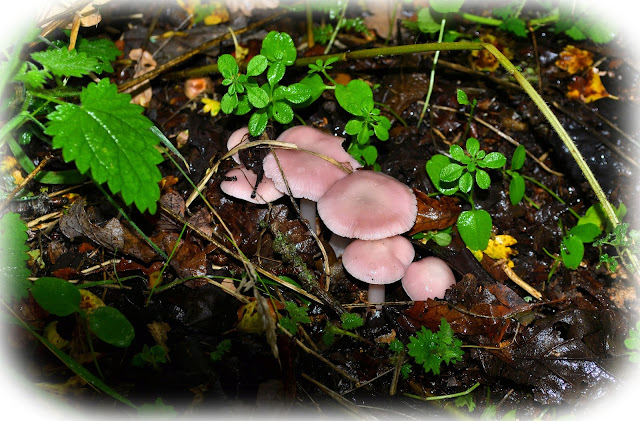 |
| Rosy Brittlegill |
Very little of Ashenbank pond in visible now being completely overgrown with reeds, there was approximately twenty Swallows hawking over and around the pond today.
18th September - Another bright sunny morning, lots of Swallows and House Martins moving over the glades, more than I have seen all summer at this site. A Nuthatch heard calling in the woods.
17th September - We have had several days of heavy rain lately making the woodland walk near impossible, today the sun was shining, the woods had that earthy damp smell, the sun was permeating through the trees in places, looking very theatrical, the photographs do not show off the effect that well. but quite spectacular.
No butterflies or dragonflies seen today, in fact woodland still seems very quiet, Jackdaws and Wood Pigeons are still plentiful, a few Wren and a single Blackbird.Woodpeckers can be heard calling but not seen today. Leaves are beginning to fall in places.
11th September - A warm sunny start to the day with a heavy overnight dew on the grass, a few bird sightings today a Grey Heron seen again flying over the woods, looked like it came from the Cobham Hall Estate opposite the wood, a Juvenile Green Woodpecker seen flying from a telegraph pole at the top of the glades, Wood pigeon heard calling unseen from high in the trees, and a few Robin scuttling around the undergrowth.
A Common Blue Butterfly seen, the first for at least a week now, Speckled Wood still around.
 |
| Common Blue |
Spiders Webs were very prominent this morning coated in the early morning dew. most were the Orb webs of the Common Garden Cross spider Araneus diadematus.
 |
| Garden Cross Spider |
I did find just one Four spotted Orb Weaver spider Araneus quadratus , I 'm sure there are more but this one was obvious in a huge Orb Web next to the footpath.
A beautiful large female covered in dew, the banded legs and lime green abdomen showing quite well, and you can just see the four white spots through the dew.
 |
Four-spotted Orb Weaver Spider
|
Some more Fungi appearing , this Beefsteak fungus was growing deep in a hole in the roots of a windblown tree,
 |
| Beefsteak Fungus |
Some more possible Sulphur Tuft fungi growing on many of the damp dead wood trees around the woodland, beginning to look very autumnal.
Not sure about the identification on the last one yet, I think I need an I.D. book.
6th September - The weathers improved, warm and sunny today, Butterflies seem to have disappeared, bird sightings were once again very sparse, although a
Grey Heron was seen flying over the glades. Fungi sightings are getting better each day with a fine specimen of Stinkhorn seen today, these do not last long, another close by had already collapsed, and a rather unpleasant smell reminiscent of a dead animal, emanating from the general vicinity of the Stinkhorn
Phallus impudicus.
 |
| Stinkhorn. |
An interesting insect sighting in the form of a Dark Bush Cricket seen resting on some bramble leaves.
 |
| Dark Bush Cricket |
5th September - An overcast dull morning with some drizzle made for a miserable walk, a few more birds on show strangely, the Tit flock was found near the open pasture in the woodland,
Great Tits, Blue Tits , Long Tailed Tits, at least two
Nuthatches were calling in the same tree as the the Tit flock but not seen. eleven
Jackdaws sitting in a Dead tree near two ponds, one
Swallow seen hawking very low over the glades.
4th September - Woodlands still very quiet, not much change over the last few weeks, trees are still loaded with berries, a few fungi specimens starting to appear. beginning to feel like autumn.
I noticed this Beefsteak fungi just breaking through on an old tree stump, I have noted this particular fungus on the same stump last year.
 |
| Beefsteak Fungus Fistulina hepatica |
1st September - Not much happening in the woodland at the moment, Butterfly and dragonfly sightings have all but disappeared, there is a very autumnal feel to the air at the moment, which is probably why sightings are few and far between.
I have encountered a fair sized Tit flock on occasion, consisting mainly of Blue, great and Long tailed Tits, ChiffChaffs and a few Blackcap, always near the Elderberry trees, and not much else of note.
The Hedgerows are full of autumn berries at the moment which bodes well for the winter birds soon to travel to our shores. So who likes what, Blackbirds have found to be wide ranging when it comes to fruits ,typically taking haws, rosehips, sloes, Dogwood, Buckthorn, Elder, Yew and Holly. although haws seem to be their preferred fruit. Song Thrush's prefer Yew, sloes, Elder and Guelder Rose and show a clear dislike of rosehips. Mistle Thrush shows a strong preference for sloes over haws. The Redwing prefers to feed on haws as do the Fieldfare.
The Blackbird, Fieldfare and Mistle Thrush can feed on rose hips, the hips being too large for the smaller Song Thrush and Redwing
Heres a selection that I have come across, some familiar, some not so familiar.
 |
| Elderberry |
The Elderberry this one is quite easy to identify and a common berry around the woodland. Elderberries seem very plentiful and attractive especially to Blackcaps.
The berry laden trees seem to attract Chiffchaffs in good numbers, not feeding on the berries but fly catching around the berries.
These are quite popular with wine makers
 |
| Rubus fruticosus - Blackberry |
The bramble or Blackberry as many people refer to it, is actually a fruiting shrub of the Rose family, a fact I was unaware of, but when you think about it, there are a lot of similarities.
They seem to be in plentiful supply this year, relished by people and animals alike. although I had to laugh when an old pensioner recently told me that he had just been scolded by another pensioner for picking the berries who had stated that these were for the wildlife.........
There seems to be plenty to go around for everyone.
 |
| Haws |
Another easily recognizable berry are the fruits of the Hawthorn known as " Haws" these can stay on the tree until February or March, they are a favoured berry of Blackbirds, Redwings, Fieldfares, also eaten by Chaffinch, Starling and Greenfinch.
These "Haws" are edible and liken to the taste of over-ripened apples,
these are commonly made into jellies, jams, and syrups, used to make wine, or to add flavour to brandy, rather than eaten fresh. although I have never been tempted to try them. Widely recognized as a cardiovascular tonic, another fact that I was unaware of is that the "Haws" can be used as a medical remedy, especially in Europe, as an approved treatment for the initial stages of heart failure,with the goal of improving patients without the use of drugs.
 |
| Sloe's |
Not so many of these around the woodland but I did find a few growing in the hedgerow and around the glades, I am pretty certain that these are the famous "Sloe" berry.
Sloes are part of the same family as plums, cherries and peaches. These berries are not usually ripe for picking until October or November, but uncommon weather conditions for the season have caused the sloes to ripen early.
Once prepared the bitter tasting sloes are mixed with sugar and gin, left for several months to make a delicious liqueur, I have yet to have the pleasure of tasting a Sloe gin liqueur,

The rose hip, also known as rose haw or rose hep, is the fruit of the rose plant, they are particularly high in vitamin C, one of the richest plant sources available.
They can be eaten raw, but care is required to avoid the hairs inside the hip. ( hairs have been known to be used as itching irritant.
Because of there high vitamin C content they are traditionally used to make a rosehip syrup, apparently this was done during the war years. They have also been used to make Herbal teas, jams, jellies, rosehip soup ? pies,bread and of course wine. The rose hips are also attractive to small mammals like the Bank Vole.
 |
| Dogwood berries ( dogberries) |
I am not really familiar with this one, there are a few bushes growing along the hedgerow, I think they are the berries of a Dogwood species, sometimes known as dogberries. It is said that the berries are regarded as poisonous, but not strictly true, just inedible.
 |
| Wayfarer tree berries. |
These Wayfarer tree berries are very abundant , especially along the hedgerows in the glades., the berries are especially attractive to both birds and small mammals, not very good for humans as eating them can lead to vomiting and diarrhea.


